Name Numerology Calculator – Chaldean & Pythagorean
What's the number behind your name?
Type any name and watch its vibration appear — instantly, in both the Chaldean and Pythagorean systems.
Your numbers will bloom here. Start typing a name above.
A name numerology calculator turns each letter of your name into a number, then reveals your core numbers — Destiny, Soul Urge, and Personality (plus your Life Path when you add your birth date) — in both the Chaldean and Pythagorean systems. Type any name in the tool above and the results appear as you type. It’s free, works instantly, and nothing you enter is saved.
How to use this name numerology calculator
The tool above does the math for you in a few seconds. Here’s how to get an accurate reading:
- Type the name. For a Chaldean reading, use the name people actually call you by, including a nickname if that’s what you go by. For a Pythagorean reading, use your full birth name.
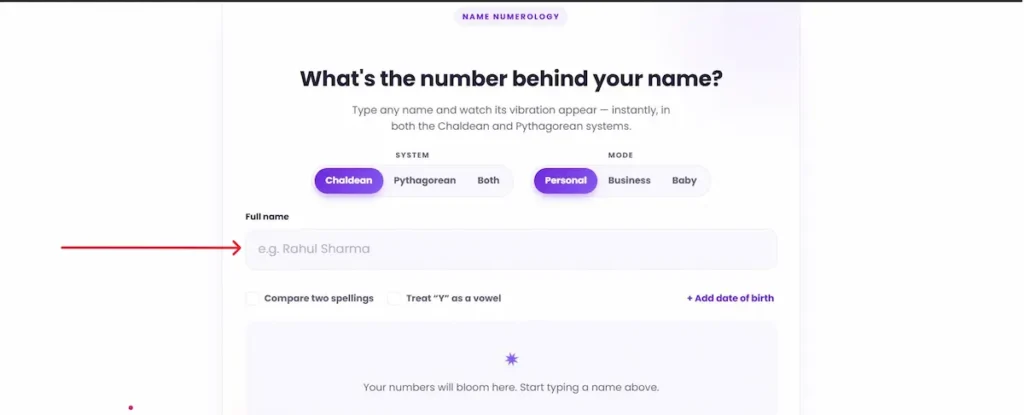
- Pick your system. Choose Chaldean, Pythagorean, or Both. Selecting Both shows the two readings side by side so you can compare them.

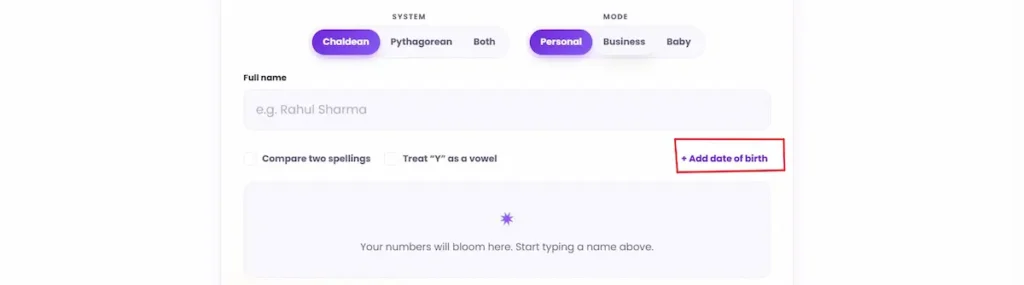
- Add a date of birth (optional). This gives you your Life Path number and shows how well your name number sits with it.
- Compare two spellings. Turn on compare to test two versions of a name next to each other — useful before a name change or when naming a baby or business.
- Read your results below. Each number updates live as you edit, with a short, plain meaning attached.
Nothing is stored, so you can test as many names and spellings as you like.
What each name number means
Every name carries a few different numbers, and each one describes a separate part of you. Here’s what they are and how they’re worked out.
Destiny Number (also called Expression Number)
Your Destiny number is the sum of every letter in your name, reduced to a single digit. It’s the headline of your name reading — a picture of your natural strengths and what you tend to build over a lifetime.
Here’s the method on the name Rahul in the Chaldean system:
- R = 2, A = 1, H = 5, U = 6, L = 3
- Total = 2 + 1 + 5 + 6 + 3 = 17
- Reduce: 1 + 7 = 8
So Rahul carries a Destiny number of 8 in Chaldean numerology. The same name gives a 6 in Pythagorean, because the two systems assign different values — more on that below.
Soul Urge Number (Heart’s Desire)
Your Soul Urge number, also called the Heart’s Desire number, comes from the vowels in your name. It points to your inner motivation: what you genuinely want, what satisfies you, and the pull behind your decisions that others don’t always see.
Personality Number
Your Personality number comes from the consonants in your name. It reflects the first impression you give — the side of you people meet before they know you well. In some Chaldean texts this is also called the Dream or Inner Dream number.
Life Path Number (from your date of birth)
Your Life Path number is drawn from your full date of birth, not your name. Add your birth date in the tool and it reduces the day, month, and year to a single digit that maps the broad shape of your journey — your opportunities, lessons, and general direction. Many numerologists treat it as the single most important number in a chart, which is why the tool checks how your name number and Life Path sit together.
Master numbers 11, 22 and 33
When a total comes to 11, 22, or 33, it isn’t reduced further. These are master numbers, and they carry a stronger charge than a single digit — greater potential, but usually greater demands to go with it. The tool keeps them intact and marks them, so you’ll see 11 rather than 2, or 22 rather than 4, whenever they appear.
Chaldean vs Pythagorean numerology — which should you use?
Both systems convert letters to numbers, but they do it differently, and they often give different results for the same name.
Pythagorean numerology assigns 1 through 9 in plain alphabetical order (A=1, B=2, and so on). It traces back to the Greek mathematician Pythagoras, is the standard in Western practice, and works best with your full birth name.
Chaldean numerology assigns 1 through 8 based on the sound and vibration of each letter, and keeps 9 aside as a separate, sacred number. It comes from ancient Babylon, was popularised by the numerologist Cheiro, shares roots with Vedic numerology, and works best with the name people commonly use for you.
| Pythagorean | Chaldean | |
|---|---|---|
| Number range | 1–9 | 1–8 (9 kept aside) |
| Based on | Alphabet order | Sound and vibration |
| Name to enter | Full birth name | Name you’re known by |
| Origin | Ancient Greece (Pythagoras) | Ancient Babylon (Cheiro) |
There’s no single “correct” one. The simplest approach is to read both — the tool shows them together when you select Both — and notice which result feels closer to you.
Number meanings 1-9 at a glance
Each single digit in numerology carries its own character. Here’s what the nine base numbers stand for, along with the planet linked to each in Vedic tradition:
| Number | Core traits | Ruling planet |
|---|---|---|
| 1 | Leadership, independence, drive | Sun |
| 2 | Harmony, partnership, sensitivity | Moon |
| 3 | Creativity, expression, communication | Jupiter |
| 4 | Stability, discipline, hard work | Rahu |
| 5 | Freedom, change, adaptability | Mercury |
| 6 | Care, responsibility, love of home | Venus |
| 7 | Wisdom, introspection, spirituality | Ketu |
| 8 | Ambition, success, material strength | Saturn |
| 9 | Compassion, idealism, completion | Mars |
No number is “good” or “bad” on its own. Each has a strong side and a weak side — a 1 can lead or dominate, a 6 can nurture or over-give. What matters is how you work with your number, not just which one you have.
Which name should you enter?
The right name depends on the system you’re reading. For Pythagorean numerology, use your full birth name as it appears on official documents, since that system is built around your given name. For Chaldean numerology, use the name people actually call you — a shortened form or nickname counts, because Chaldean works with the name that carries your everyday identity.
Add your middle name only if you regularly use it. And remember that spelling matters: even one extra or changed letter shifts the total, which is exactly why some people test different versions of their name.
Name correction and choosing a lucky name
A name’s number changes the moment its spelling changes, because you’re adding or removing letter values. Take Rahul in Chaldean numerology — the letters total 17, which reduces to 8. Add one letter for Rahhul and the total becomes 22, a master number. That single change gives a completely different reading. You can test any two spellings side by side using the compare option in the tool.
This is the idea behind name correction: adjusting a spelling so the name carries a number a person prefers. Many practitioners consider 1, 3, 5, and 6 favourable for names, though this is a common view rather than a fixed rule — the number that suits you also depends on your birth details.
Two honest points worth keeping in mind. First, a name number sits best when it works with your Life Path number, which is why adding your date of birth gives a fuller picture. Second, numerology is a tool for reflection. It can shape how you present yourself, but it doesn’t replace effort or decide your future for you.
Who uses a name numerology calculator
People come to a name numerology calculator for a few clear reasons:
- Understanding your own name — reading your Destiny, Soul Urge, and Personality numbers to see what your name reflects about you.
- Naming a baby — checking how a chosen name sits with a child’s birth number before deciding. Our baby name numerology calculator is built for this.
- Naming a business or brand — founders test a company, brand, or product name for the impression it carries. The business name numerology calculator handles this.
- Comparing spellings — anyone weighing a name change lines up two versions to see which number they’d rather carry.
How name numerology is calculated (the method)
The method is simple once you see it. Every letter maps to a number, you add those numbers, then reduce the total to a single digit — unless it lands on a master number.
In Pythagorean, letters run 1 to 9 in order: A=1, B=2, C=3, up to I=9, then J starts again at 1. In Chaldean, letters run 1 to 8 by sound, with 9 kept aside.
Here’s a full Pythagorean example on Rahul:
- R=9, A=1, H=8, U=3, L=3
- Total = 9 + 1 + 8 + 3 + 3 = 24
- Reduce: 2 + 4 = 6
For the Soul Urge number you add only the vowels (A, E, I, O, U). For the Personality number you add only the consonants. The letter Y can act as either, depending on how it sounds in the name — the tool lets you set whether Y counts as a vowel, so your reading stays accurate.
If a total reaches 11, 22, or 33 at any stage, you leave it as it is rather than reducing it.
Is name numerology accurate — and what it can’t do
Name numerology is a symbolic system, not a science. It has been practised for thousands of years across Babylonian, Greek, and Indian traditions, and its value lies in reflection — a structured way to think about your name, your tendencies, and how you present yourself.
What it doesn’t do is predict events or guarantee outcomes. A number won’t decide your success, your relationships, or your future. Read it for insight and for interest, treat the meanings as prompts rather than verdicts, and keep your own judgement in the driving seat.
Frequently asked questions
What is my name numerology number?
Your name numerology number is the single digit you get after converting each letter of your name to a value and adding them up. The main one is your Destiny (Expression) number, from all the letters. Type your name in the tool above to see it in both the Chaldean and Pythagorean systems instantly.
How do I calculate my name number by hand?
Match each letter to its value from the numerology chart, add them together, then reduce the total to a single digit by adding its digits. For example, a total of 24 becomes 2 + 4 = 6. If the total is 11, 22, or 33, you keep it as a master number instead of reducing.
Chaldean or Pythagorean — which is more accurate?
Neither is officially “more accurate” — they’re two different traditions. Pythagorean is the common Western system and uses your full birth name. Chaldean is older, sound-based, and uses the name you’re known by. Many people read both and see which fits, which is why the tool shows them together.
Should I use my full name or my nickname?
Use your full birth name for a Pythagorean reading and the name you’re commonly called for a Chaldean reading. If you go by a nickname every day, it’s worth checking too, since that’s the name carrying your identity. Include a middle name only if you actually use it.
Can changing my name’s spelling change my number?
Yes. Every letter adds a value, so adding, removing, or swapping even one letter changes the total and can change your final number. This is the basis of name correction. Use the compare option in the tool to see how two spellings differ side by side.
Which name numbers are considered lucky?
Many practitioners view 1, 3, 5, and 6 as favourable for names, but this is a general view rather than a rule. The number that suits you best also depends on your birth date, so a name that harmonises with your Life Path often matters more than the digit alone.
Do I need my date of birth to use this?
No. The calculator gives your Destiny, Soul Urge, and Personality numbers from your name alone. Adding a date of birth is optional — it unlocks your Life Path number and shows how well your name number sits with it, for a fuller reading.
What are master numbers 11, 22 and 33?
Master numbers are 11, 22, and 33, and they aren’t reduced to a single digit. They carry a stronger charge than ordinary numbers — more potential, but usually more pressure to match it. When your name or birth date totals one of these, the tool keeps it whole and marks it.
Is name numerology scientific?
No. Numerology is a symbolic tradition, not a scientific method, and its results aren’t proven predictions. People find it useful for self-reflection and for exploring the meaning behind a name, which is how it’s best approached — as insight, not fact.
Do you store the names I enter?
No. Everything is worked out in your browser as you type, and nothing you enter is saved or sent anywhere. You can test as many names, spellings, and dates as you like with full privacy.
Try your name in both systems in the calculator above, and add your date of birth to see your Life Path number and how well it matches your name.